What is a homiletic?
The six steps of a homiletic, explained with a worked example from Romans 3:1-20.
A homiletic is a short, structured way of studying one passage of the Bible. You read the passage closely, find its main message, and then think about how to live it out. Bible Study Fellowship (BSF) classes use it, and it works just as well on your own.
It takes six steps. Your first few won’t be perfect, and that’s fine — it gets easier every week.
Below, each step is explained and then shown with a real example from Romans 3:1-20.
Before you start
- Read the passage two or three times. Don’t write anything on the first read.
- Keep the text in front of you. In the app, the passage stays open above (or beside) your notes.
- Use your own words. The point is to understand the passage, not to copy it.
The six steps
Step 1 · ContentContent summaries
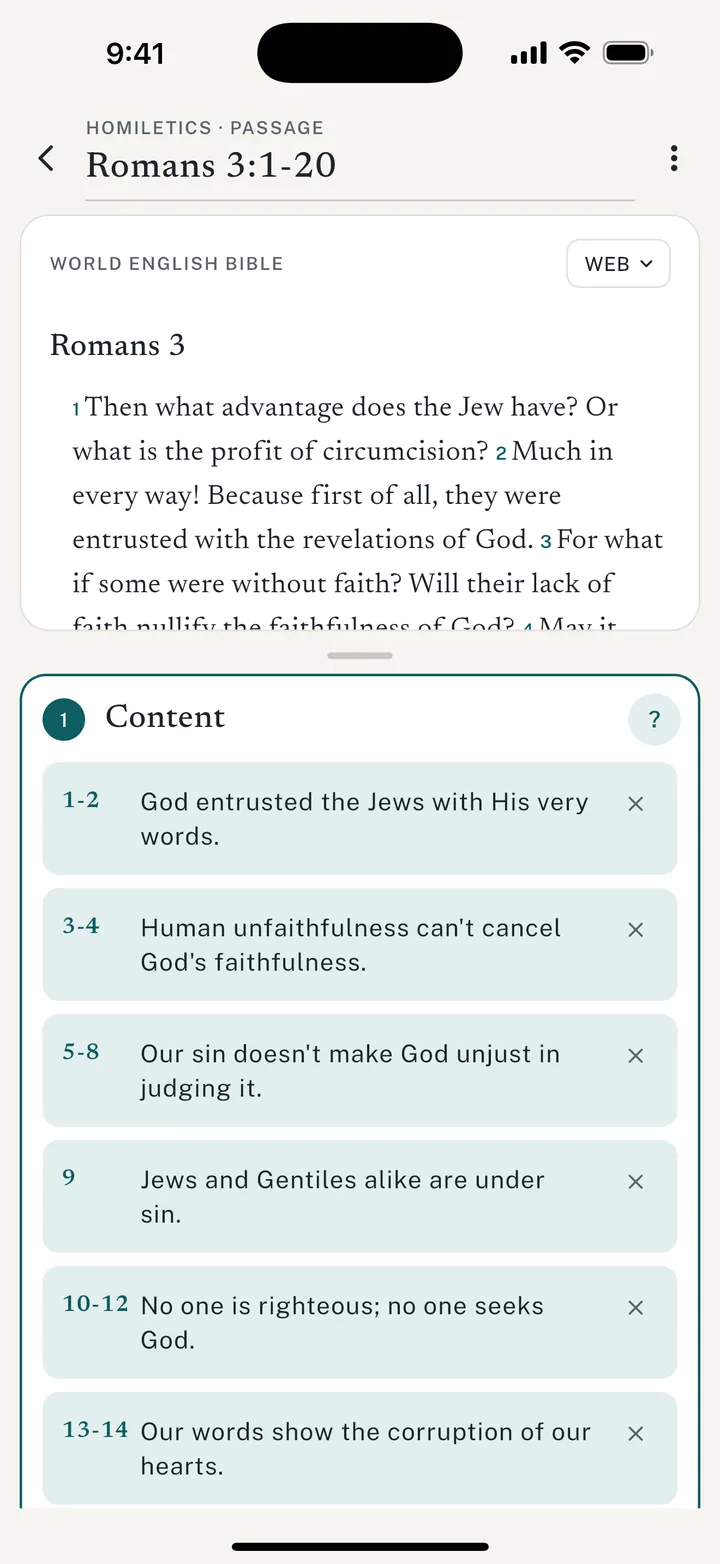
Break the passage into small chunks and summarize each one in your own words. A summary doesn’t have to be a full sentence, and it can be more than one.
Aim for 10 to 20 summaries. For a 20-verse passage, that’s roughly one summary for every one to three verses.
| Verses | Summary |
|---|---|
| 1-2 | God entrusted the Jews with His very words. |
| 3-4 | Human unfaithfulness can’t cancel God’s faithfulness. |
| 5-8 | Our sin doesn’t make God unjust in judging it. |
| 9 | Jews and Gentiles alike are under sin. |
| 10-12 | No one is righteous; no one seeks God. |
| 13-14 | Our words show the corruption of our hearts. |
| 15-18 | Our ways lead to ruin; there is no fear of God. |
| 19-20 | The law silences every mouth and shows us our sin. |
This example has eight summaries to keep it short. On a full lesson, split it a little finer to reach ten or more.
Step 2 · DivisionsDivisions
Group your content summaries into two to four divisions — sections of verses that belong together. Give each division a short sentence that sums it up.
| Verses | Division |
|---|---|
| 1-8 | God stays faithful even when His people fail. |
| 9-18 | Scripture’s verdict: all are under sin. |
| 19-20 | The law shows our need, not our righteousness. |
Summary sentence
Sum up the whole passage in 10 words or fewer. Try the “2 a.m. test”: if someone woke you at 2 a.m. and asked what the passage was about, what would you say? If you’re feeling ambitious, try an alliteration.
Step 4 · FCFGod is faithful; every person is guilty before Him.
Fallen Condition Focus (FCF)
The FCF is the part of our broken human condition that the passage most clearly shows or speaks to — the reason we need God’s help. Some people remember it as fallen, frail, feeble or fickle.
Step 5 · AimWe excuse our own sin and assume we are better than others.
Aim
The aim is the one main truth you want yourself, or anyone you’d teach, to walk away with. It usually answers the FCF and shapes your application questions. It traditionally begins “Cause the audience to learn that…”
Step 6 · ApplicationCause the audience to learn that the whole world is accountable to God, so we need His righteousness, not our own.
Application questions
Write questions that turn the passage into everyday life. Good ones are specific, personal, open-ended and thought-provoking — not answerable with yes or no. Many start with “How can I…”.
- Where am I comparing myself to others instead of to God?
- What excuse do I make for a sin I keep returning to?
- How can I thank God this week for His faithfulness?
Tips
- Content first, then work down. The divisions come from your summaries, and the summary sentence comes from your divisions.
- The FCF and aim go together. If your aim doesn’t answer the need in your FCF, look at both again.
- Stuck on the summary sentence? Read your division sentences out loud, then say them again in one breath.
- Don’t aim for perfect. A finished homiletic you wrote yourself teaches you more than a polished one you didn’t.
Ready to try it? Read Writing your first homiletic in the app, or print a blank homiletic worksheet.